Friday, April 12, 2013

Payne Hollow Primer


 This is a writing for young children-an introduction to Payne Hollow.  Each text is for one page and one illustration.  Something I plan to do.  I plan a combination of calligraphy, painting, sewing, and use of a vintage printing set.  I also like the idea of an altered book; modern illumination.


·         Magic is a word sometimes used to describe a feeling we have when we understand                 
          something special.


·         The story of Harlan and Anna Hubbard is special.  They chose to live in a secluded 
           river hollow.


·         A river is ever changing and always interesting.


·         Walking the steep trail down into Payne Hollow was like finding a secret garden.


·         Close to the river, they built a cottage of stone and wood.  It was peaceful, so the   
          birds stayed too.


·         Without electricity, the house was always kept neat and orderly.


·         Harlan enjoyed hard work. He collected driftwood and managed the woods where                     
          trees harvested allowed others to grow strong.


·         They made wood fires every day for cooking and keeping clean and warm.


·         The garden was the center of their living-a green growing place full of butterflies and 
           bees.


·         A large part of the garden was preserved.


·         They delighted in the goat herd and beloved dogs.


·         Anna was a careful homemaker.  She prepared tasty meals with whatever became 
          available, including wild foods.


·         She enjoyed reading to children and writing letters to loved ones.  To her, moonlight 
          on the river was a gift.


·         Who could be bored?  Best of all was the time left for playing music or reading 
          together.


·         While one person read, the other did handwork like knitting or shelling nuts.


·         Harlan painted pictures or made woodcut prints of the river and hills.


·         He made things in the workshop, like the handy wheelbarrow he used so often.


·         There, with a hand turned mill, he ground grains into flour for their daily bread.


·         Plastic milk bottles scavenged from the river became candled lanterns.


·         They never stopped learning, and made use of what was at hand.


·         The Hubbards treasured their family and friends.


·         They crafted a rich life they made for themselves.


·         He wrote books about the things they did.


·         Then people tried to find them, coming in their boats to search behind the willows.


·         Payne Hollow became well-known, as in the days when riverboats stopped there.


·         Harlan Hubbard, with Anna at his side, lived most of his life happily in the deep 
          woods.  Success was found in common hours.


·         Now, more people understand something special was hidden and found in a hollow.  
          Maybe you understand something of the magic already.

Tuesday, April 9, 2013

Anna in Michigan

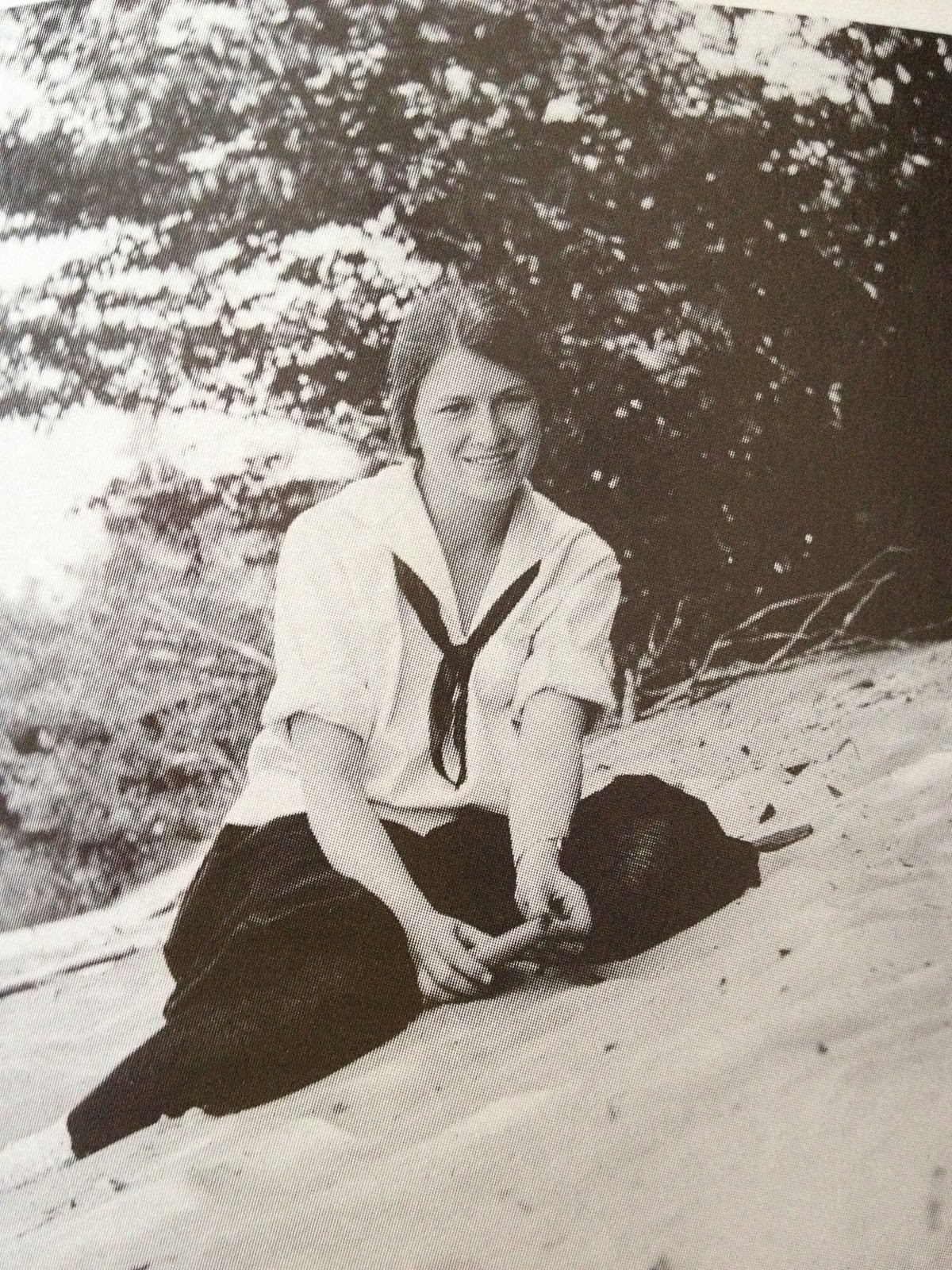
Anna Hubbard grew up in Grand Rapids, and spent many vacation hours on the sands of Michigan.  The atmosphere and terrain is very different from the Ohio river valley, but it gave Anna a good background for the camping and boating she would do with Harlan.

When we took a trip around Lake Michigan not many years ago, we kept an eye open for the small lakes Anna's family enjoyed.  The following essay came out of our finding the dunes of the Sleeping Bear Dunes Nation Lakeshore.  'The Legend of Sleeping Bear', by Kathy-jo Wargin is a beautiful and touching telling of the story.  I highly recommend it, as it will enhance your understanding of my wonderful experience.


Sleeping Bear Dunes National Lakeshore

Finally I've come to a low spot in the road where I might make it to the beach, and it's opening out to a small parking-lot within view of the water.  Earlier along this scenic drive I stopped at a lookout point and stood there with my feet solidly planted into fine white sand...but the rest of me reeled with surprise.  I wasn't expecting to see such sweeping views from a dune, but this was a mountain of sand so immense that gulls flew below me, skimming the rippling sapphire of the lake.  And the wind!  The wind tugged and buffeted at me so that my spirit soared with the gulls and I felt that I too should by flying.

There is a story about this beach I stand on, and about the two islands I can see from here.  Many moons ago a mother bear encouraged her two cubs to swim after her to escape from a fast moving forest fire.  Across the great lake, all night, the mother bear swam, calling her cubs after her. When the exhausted mother bear made it to shore, she waited, but sadly the cubs were lost.  Ojibwa legend explains the two islands off shore rose in memorial to the cubs.  As the wind blew, the mother bear continued her vigil until until her own life drained away on the beach.  It is said a small unmarked dune remains in her final resting place.

Now I scan the horizon in search of a bearlike mound.  I am conscious of the shared experience of dedication, loss and hope, so my energy surges.

Kicking off my shoes feels so free and good that I pick up pace, enjoying every sinking strenuous step in the soft cool sand.  This I can do.  Sand blows in my face, but it can't stop me now.  I see her! A small eroded dune covered in fur-like grass, but strangely surrounded by bare, clean sand. I circle around to the other side where no human can see me.  Waves pound along with my heart as I throw my arms wide open and allow myself to fall into the full round of the hill.

Sunny childhood days spent on the shores of this beautiful lake are still with me.  It's been a long time since I've played in the sand, and today I am content to be hugging a sleeping bear.

*Above:  The young Anna on a Michigan dune.  Photo courtesy of George Bartnick
*Nancy and Judy play on the shores of Lake Michigan.

Monday, March 18, 2013

Walking the Ancient Way


When she looked at you with her clear wise eyes, you knew you had been seen.  Yet often her henna-tinted head was bent away from the sun she almost worshiped, as if her brow carried the weight of years of knowledge and experience.  Juliette had much to do, so she kept moving, her skirts swinging with a slow flowing stride that followed the sure rhythm of her life.  I watched her go.

Juliette tended wayside gardens around the world.  Nothing grand; her needs were simple and her life too nomadic for anything else.  Her curiosity was the grand thing, so she experimented with gardens.  The plants and the places.  A small island in the Azores off the coast of Portugal.  Mexico.  A rocky hillside on an island in Greece where in the center of the garden stood an ancient olive tree.

When she was a young woman, she lived near the Sea of Galilee with her children.  They swam and bathed there, and the children, brown as wheat berries, combed the shores for small cut mosaic stones washed from the floors of the fallen palace of Tiberius, the son of that terrifying emperor Nero.  Each day they took the animals along to the water.  Always, they had a faithful guard dog.  Even the pet owl followed, flying from tree to bush, waiting as they slowly made their way to the shining beach.  When they found fruits or herbs to eat, they gathered them together.

Juliette took time to teach her children about the natural world around them, and she delighted in telling them stories.  A favorite one was about the holy babe in a stable, where the scene was of the wonderful peace of a happy , quiet family, and the swaddled little one lay sleeping in a manger of clean straw.  The animals there, were also at peace, their sweet breath and contented sounds and the warmth from their bodies keeping them all warmer.  Oh, the joy of it!  They learned, and they thrived in the open air.  Nature’s children.

Born into extreme wealth, Juliette was the child who chose a puppy over riches.  At a time when women usually stayed in the home, Juliette opened locked doors and became one of the first holistic veterinarians.  While practicing in the field, using the latest scientific knowledge, she noticed that the simple people of the earth were often the most successful finding good health for themselves and their animals.  So, she changed her direction in medicine.

She studied and collected medicinal herbs wherever she wandered, and she learned the ways of the Gypsies, Bedouin, or other native peoples.  Juliette well understood that people like the bush tribes of the Kalahari Desert, were so skilled in their environment that they could survive in the harsh climate.

Juliette so respected the practical wisdom of the native peoples that they came to trust her, allowing her into their lives.  Observing all she could with her kind, wise eyes, she patiently learned their ways.  Many also watched Juliette, and they saw she would walk softly on the earth; she would not take more than what was needed or safely allowed.  The earth was treated with respect, and another gatherer would pass along the way.

One heavy snow-covered winter in England, a flock of sheep were seriously failing.  Juliette asked the sheep be fed ivy.  “Mares eat oats, and does eat oats, and little lambs eat ivy.”  Experiment and try; the sheep didn’t die.  Then Juliette became known among the nobility, and no matter what praise fell on her, joy remained in the simple things.

But the wind blew and hissed hot from Chernobyl.  Everything in it’s path over-produced because of radioactive fallout.  The ancient olive tree in her garden became sick.  On her island of heart-shaped stones, this was a thing unheard of, but Juliette tended her tree with devotion, putting ashes from her fires around it to drive away ants.  Experiment and try.  It helped.

“Where bees can live, man can live,” Juliette often said.  “But the bees are dying.”  She didn’t understand greed; the bees cannot tolerate greed, yet they are robbed of much more than honey.  We have more to learn.  Juliette remembered from scripture God’s promise to bring to ruin those who are ruining the earth.  “We have our warning,” she murmured with urgency.

On a warm summer day , I saw her move away one last time.  Her skirts swung slowly with the steady rhythm of her own ebbing life.  I watched her go.


(This photo is taken of Juliette de Bairacli Levy in approximately the year 2000.-The above writing about her was published in Union County Writers Group Anthology of Poetry and Prose, 2007.)

Connections


Helen Nearing, Juliette de Bairacli Levy, Harlan and Anna Hubbard, and me.  Each is a link that forms a full circle of connections for me.  From earliest memory, fascination with the rustic life was strong .  Growing up in the heart of a huge city like Chicago could not change it.  I spent happy hours in the unkept yard of our second story apartment examining weeds in total fascination.  In childhood I could be happy making tents and mud pies, but later I found inspiration in others who took the wild path.

Helen Nearing is probably the first one who got my attention via Mother Earth News magazine.  Helen and Scott were at the front of the back-to-the-land movement.  I read most of the Nearing books and was inspired by their sun-heated greenhouse.  I still have and use Helen’s no-cook cookbook, Simple Food For The Good Life.  She was a salty gal who spoke her mind.  Had to love her. 

Juliette de Bairacli Levy came to my attention in the 70’s when a local herb farmer told me about her favorite herb writer.  Juliette soon became my favorite too.  I didn’t know then that she was one of the first to use holistic veterinary medicine.  Her book, Nature’s Children was a constant in the raising of my two children, and herbs later became a big part of my care for horses and dogs.  If anyone was the earth-mother type, it was Juliette.  We met her at the 1997 HerbFest put on by Frontier Herbs in Norway, Iowa.  She was a joy!

It took me over ten years to search out and read every one of her books.  But her three booklets of twenty poems each are almost impossible to locate.  However, Juliette copied and sent me one of the poems.  That was Juliette.

Later it came to my attention that Helen and Juliette knew each other, and well.  Helen wrote at least one introduction to one of Juliette’s books.  When I learned Helen had a copy of ‘Look! The Wild Swans’, a novel I had been trying hard to find, I wrote Helen about it, and she offered to loan the book to me; leather bound, gold leaf and all!  I read it quickly and returned the treasured item.  

Offers of some favor to Helen in return were replied to as unneeded, so I sent her Payne Hollow and Shantyboat to read.  The Hubbards had come to my attention via Organic Gardening magazine, and their lifestyle was a deep ongoing interest.  Her concise reply, 'Thank you, thank you for lending me these fine books.  Real river, and real people!'  Love, H. So like Helen!  

For me, the connections formed full circle.


This poem of mine was published in the Shawnee Hills Review in 2008

Mud Pies

A red rose up in Spanish Harlem...
Someone explained this mysterious song is about a girl, 
like a rose.

I know about growing up through the concrete,
so soft and sweet...

Am I not being forced like a bulb to bloom in the city too?
So much so, that I seek out patches of earth
and delight in anything alive here.

The Latin beat pulses down from Grandpa's radio
to my given spot in the yard where I have peace to think,
and dig with fury
making spectacular mud pies.

Music adds drama to this place where I have been planted,
low and closely rooted to the ground
where observation is so intimate, almost secret,
and I can concoct anything I please.

How delicious is the scent of the earth!
How satisfying to see my collection of empty bottle caps
packed full of fresh dirt:
Miniature tarts and casseroles set down neatly in a row,
waiting to be shared.

Lyrics from "Spanish Harlem" by Jerry Leiber and Phil Spector, Atco Records, 1961.


Tuesday, February 19, 2013

Girl In White

I've spent many hours of wonderment touring the Art Institute of Chicago.  It started when I was given a Saturday morning semester course there for being the most promising art student of my eighth-grade graduating class.  However, my sharpest memory of the experience was not the class, but traveling on the bus along the outer drive watching the water on Lake Michigan. Sometimes high winds shot waves against the rocks and into the air to what looked like twenty feet high, and in really cold weather, ice formations became fantastic.  It's understandable that in 1963 my husband and I decided to spend our one-day honeymoon at this fine museum built so close to the wild lake.

Years later, in the spring of 1986, something interesting began to develop while visiting the museum gift shop.  I found a card that was blank inside with a painting I liked on the cover; one in the white girl series by James McNeill Whistler.*  I remember that Kentucky artist and writer Harlan Hubbard also admired Whistler's work, so even though correspondence between us had been brief and limited, I decided to send the card to Harlan and Anna to tell them how much I was enjoying his books.

In a short time I received an unexpected note from Harlan telling me he was 'intrigued' with the painting on the card.  Then I tucked the note away with the satisfaction of knowing that a random act of kindness brought some small happiness.  I didn't notice until later the significance in the note being signed Harlan Hubbard, and not H and A Hubbard, like my other correspondence from him.

I don't remember when or how I learned that Anna was gone.  She had passed away on May 4, 1986.  Harlan's note to me is dated June 29, l986.   The card I sent reached him somewhere between these dates, but I didn't know that then.  The Little White Girl had become something of an accidental sympathy card.

What more may have happened finally dawned on me after Harlan and Anna were both gone. Harlan's last note had let me know the Whistler painting stirred him.  Now I am the one who is intrigued, because when I saw the the painting again-its quiet, mysterious quality, the girl so unassuming with an almost angelic look...suddenly I envisioned a young Anna.  You can easily say I imagine too much, but I think Whistler's painting does look like her.  It certainly captures the essence of her for me.  What was Harlan thinking?  I guess we will never know.

*Symphony in White No. 2: the Little White Girl Series 1864, James McNeill Whistler